Dance Descriptions from
Early 20th Century Sources
|
|
|
MR. AND MRS. VERNON CASTLE’S
NEW DANCES FOR THIS WINTER
WITH PHOTOGRAPHS OF EACH STEP
ESPECIALLY POSED BY
MR. AND MRS. CASTLE
PHOTOS COPYRIGHT BY IRA L. HILL’S STUDIO
|

|
1: THE CASTLE POLKA
DESCRIBED BY MR. CASTLE
BEFORE I explain the polka it might be well to tell why I think it should
be revived and modernized-not to take the place of the other dances so popular now, but to add variety to all dance programs.
We have at present a leaning towards things old-fashioned. This is most noticeable in the quaintness of the fashionable
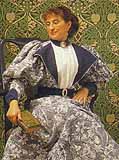
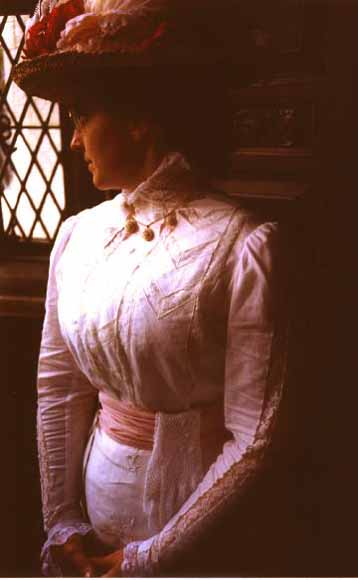
woman’s attire. In fact my wife is wearing at parties the dress you see in these photographs.
Possibly the most important excuse for a revival and modernization of the
polka is because it is easy to learn and so enjoyable to dance. In the polka you hop rather than slide, which is exactly
the opposite to the usual steps in out present-day dances. This hop, if not exaggerated, is most graceful. The counting
for this dance is 1-2-3-hop, 1-2-3-hop. You do the hop after the third step-that is, if you start this way: left, right,
left, hop, the hop comes on the left foot. If this is clear to you it is safe to take up the dance itself, which I will
explain by imagining myself the instructor and you my partner and pupil. If you happen to be a man you must put yourself
in my place and study my description in that way.
To commence we assume the usual dancing position for both to go forward. I
start on my left foot and you on your right (this will be better understood from our first photograph). Now we start dancing
the polka step in this position, going forward around the room.
|

|
|
|
|

|
This is the first figure, which (while we are learning) we
will do eight times.
For the second figure I swing in front of you and we continue the same steps
facing each other, turning the while as in the two-step (second photograph). You must be very careful not to hop until after
the third step, and also, when you do hop on the one foot the heel of the other should come up, as Mrs. Castle’s foot is in
the third photograph. This step we will also do eight times.
The third figure is very simple and very pretty. I release my right hand,
which is around your waist, and we bow to each other as in the fourth photograph. The time for this bow is eight beats- four
to make the bow and four to straighten up again. After that we commence the polka step again. I start on my left foot and
you on your right foot, as before.
The fourth and last figure is not quite so simple. While we are facing each
other doing the ordinary polka step we change hands-that is, I take your right in my right and your left in my left, your
right hand being behind your back. Now to make to the change I do two ordinary walking steps, and you turn a little so that
you (keeping on with the polka step) are at my side instead of facing me. After my two walking steps we go into the polka
again, and in the position seen in the fifth photograph. This is all there is to the polka, and, to get back again to the
first figure, all I do is to take two more walking steps and take the original hand position.
|

|

P.O. Box 9, Nahant, Massachusetts 01908
e-mail:
phone: (781) 49-WALTZ (781-499-2589)
© 2011, Vintage Victorian, All rights reserved
|
|
|
|
Quick Links:
Coming Soon!
Ladies Evening Dress:
the Early Jazz Age:1920-1924
Attend our Ball!
Come to the Nahant Victorian Day Ball
July 16, 2011
with music by Spare Parts
last updated 25 may 2011/csb
|