Finishing Touches
Hairstyles and Fashion Accessories for 1890's Evening Attire
A quick guide to the finishing touches appropriate to an 1890's evening ensemble.
The majority of the text is straight from original period sources, many with accompanying illustrations.
|
|
|
|
|
|
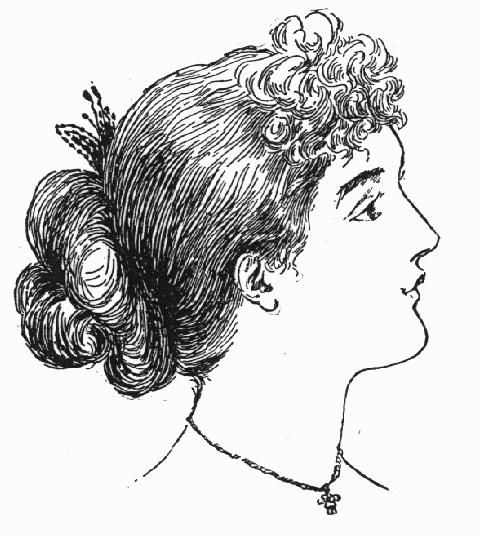
1890's low coiffure
|
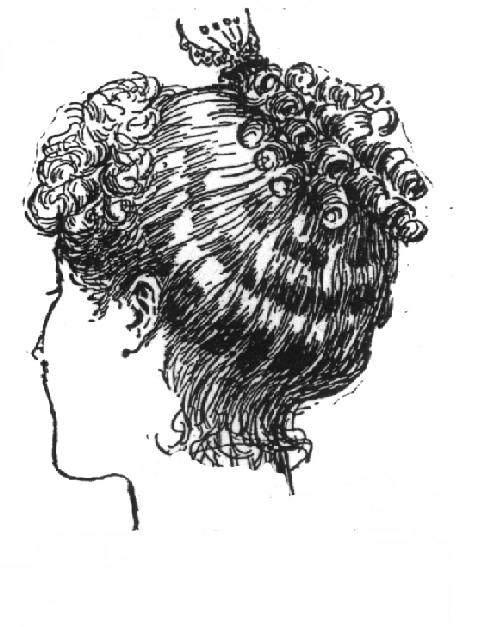
1890's high coiffure
|
|
|
|
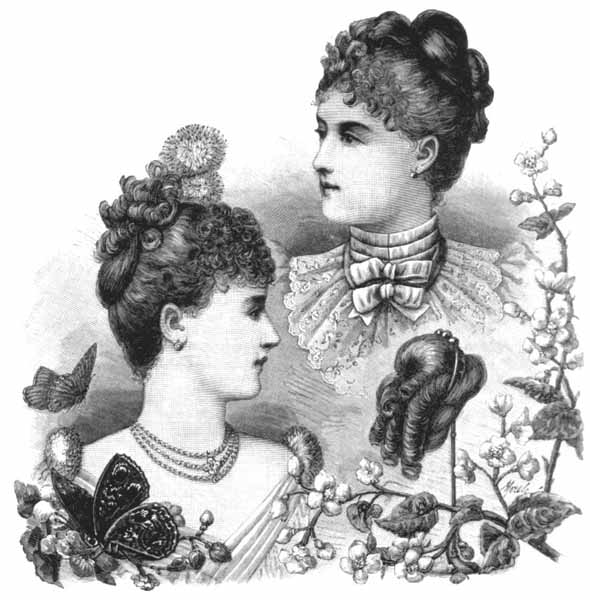
This image is from the early 1890's, the hair is dressed fairly close to the head with curled fringe at the forehead
and fairly high buns. This plate also shows a ready-made bun, with small coronet attached, one can store in a box and plop on one's
head with no fuss at all. Note also the triple strand necklace and small drop bead (pearl?) earrings and ostrich(?) feather puff
aigrette..
|
Hair-Dressing
Harper's Bazar, 16 January 1892
|
|
This hairstyle from 1893 comes with instructions!
Lady's Coiffure.
To carry out this coiffure successfully the hair should be quite dry and fluffy, free from grease. The front hair is
divided off and parted jauntily on the left side. Just back of this a tress is plaited and pinned down as a sort of foundation.
The upper part of the front hair is drawn back loosely and pinned, then twisted, and coiled first into a small loop that rests in
the parting, then brought down along the right side as illustrated. The back hair is divided across, and the upper part with part
of the front hair added is twisted and coiled around over the first coil. The lower part is drawn up in a small knot with an open
loop above. A small shell comb is thrust into the knot.
Harper's Bazar, 22 April 1893
|

Hair-Dressing
Harper's Bazar, 22 April 1893
|
|
The following 2 hairstyles are fairly late in the 1890's, notice how full the hair is, it is the very beginning of the Gibson
Girl pompadour style.
Figure 1: Evening Coiffure.
1. In this coiffure the hair is arranged in large loose waves,
the front formed into a soft Pompadour and the back fluffed
out at the neck. The hair is rolled into three horizontal
puffs across the back, with three tiny ringlet puffs at the
sides. For ornaments there are three shell combs, two close
to the puffs at the sides, and one at the back. A knot of
ribbon is toward the side at the top, and this holds a few
artificial ringlets in place.
Harper's Bazar, 9 January 1897
|

Evening Coiffure
Harper's Bazar, 9 January 1897
|
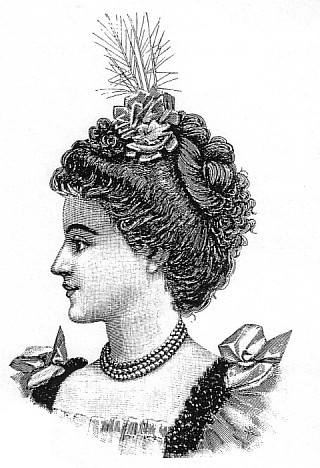
Figure 2: Evening Coiffure.
2. In this figure there is the same general arrangement, but instead
of the three puffs the hair is divided into three strands, which
are intertwined into a knot, the ends finishing in fluffy ringlets.
A pink chiffon chou holds the stem of an aigrette.
Harper's Bazar, 9 January 1897
|
Evening Coiffure
Harper's Bazar, 9 January 1897
|
|
Tiaras are seen frequently, often with rhinestones and pearls in both gold and silver,
short bead necklaces, often with multiple strands, bracelets, of pearls or gold are also quite fashionable. Earrings can be
dangles, either long or short.
|

Evening Toilette
Harper's Bazar, 8 February 1896
|
|
Pearl chokers are worn fairly often, as well as jeweled necklaces and short bead necklaces. Pins and brooches are usually worn at the center front neckline, in gold, with colored stones or
pearls. Flowers or small feather headdresses can decorate the hair
|
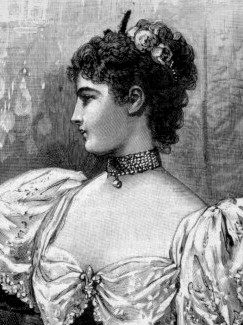
A Paris Dinner Gown
Harper's Bazar, 24 February 1894
|
Fans and Fan-Bags.
A Black silk fan with gold lines and scrolls framing a delicate water-color painting has a new style of frame,
which surrounds the fan entirely when it is closed, and can be opened by pressure on a spring-catch. A view of the fan closed is
given in the illustration.
Another large fan shown has a gilded frame and a shallow spangled black net cover, in which a painted silk panel is inserted.
Here and there among the fans of large and medium size the small empire fan is beginning to make its appearance again. That
illustrated has ivory sticks with gold ornamentation, and a white Japanese crape cover with a border of applique lace and gold
spangles.
For the fragile beauty of many handsome fans a fan pocket is a necessary protection, and several are illustrated herewith. One
for a large ostrich-feather fan is made of light brocade lined with turquoise satin. It is twenty-two inches long, four inches
wide at the lower end, seven at the upper end, but is considerably widened by inserted sides two inches wide. A ribbon draw-
string is four inches below the top. White lace eight inches deep is gathered around the outside, and another five inches deep
around the inside of the draw-string casing. A smaller bag, made of copper-colored broché ribbon four inches wide, is
seventeen inches long, and open four inches deep at the top. It is lined with India silk, and one side is bordered with gold-
threaded lace which terminates under a ribbon bow near the lower end. A third, made of black and pink brocade lined with pink
satin, has for a flap a spangled passementerie point, and is completed by bows and loops of pink ribbon.
Harper's Bazar, 24 November 1894
|
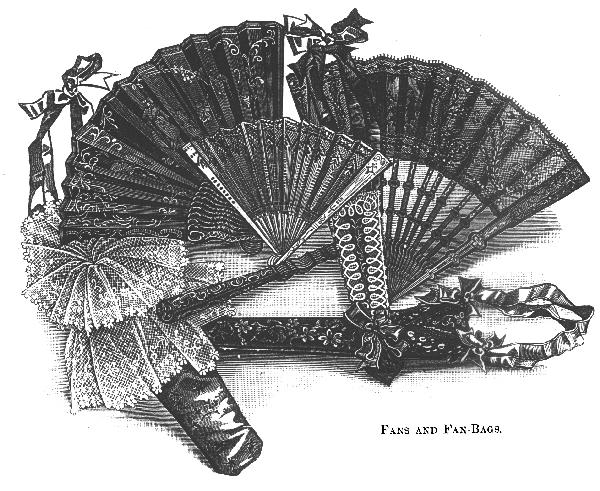
Fans and Fan-Bags.
|
|
Large ostrich feather fans are fairly common 1890's evening accessories. They are usually in black, white or
a color to compliment the gown.
|
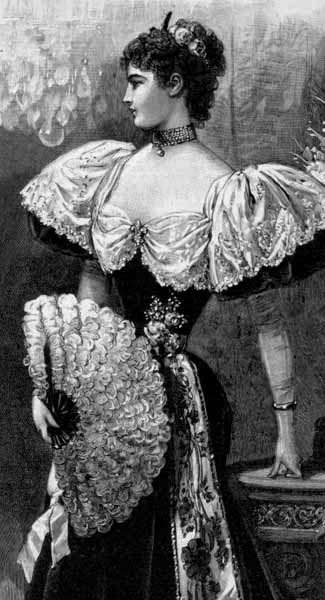
A Paris Dinner Gown
Harper's Bazar, February 24, 1894.
|
|
Fans can be suspended from the waist with ribbons, specialized hooks, or chatelaines, though elaborate metal
chatelaines are not recommended for dance wear as they will probably not withstand the rigors of dancing and may damage your dress
or the outfit of your partner.
|
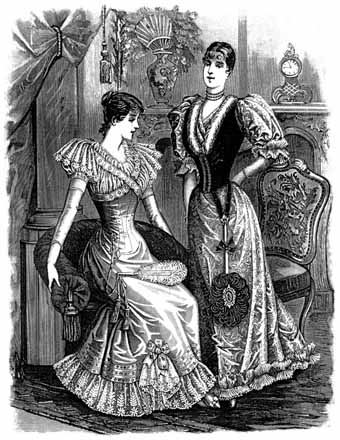
Evening Toilettes
Harper's Bazar, 14 January 1893
|
SHOES and STOCKINGS
|
|
|
1892 Slippers
|
1892 Strap Pumps
|
|
|
|
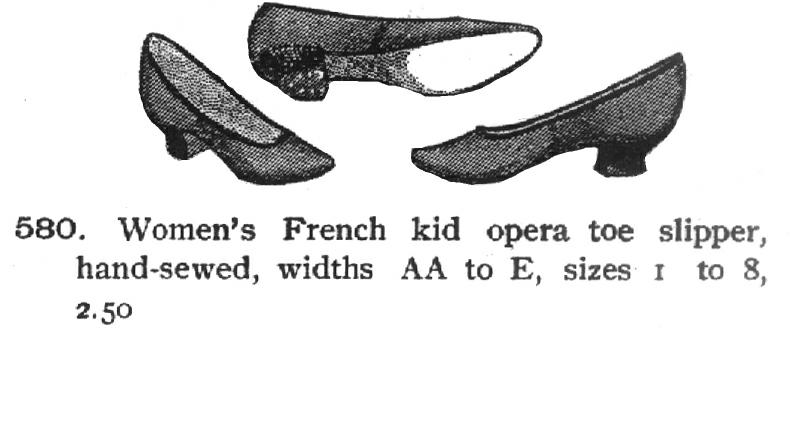
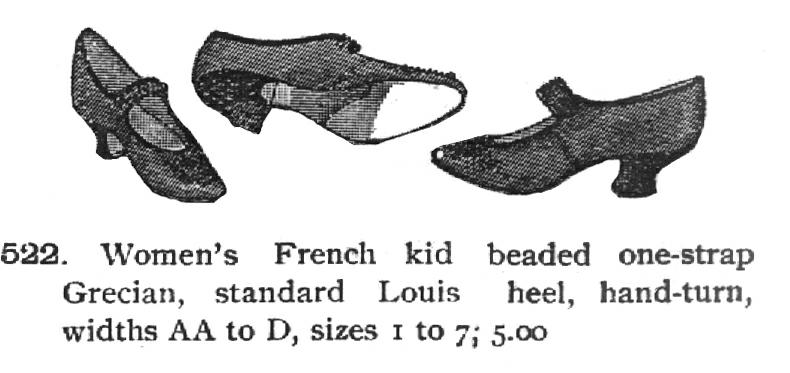
White satin slippers with pointed toes trimmed with rosettes of mousseline de soie, very large and full, are
worn with dresses of any color. But white gloves and slippers give the effect of large hands and feet, and while there is nothing
to vie with the white gloves, the slippers may give place to those made of the material of the gown, or else to the black satin
slipper which makes the foot look very small.
Harper's Bazar, 1 December 1894
With evening toilettes stockings match the slippers, which are of the material of the dress, or else of satin, moire, or suede of the same color.
Harper's Bazar, 7 April 1894
|
Evening Ties and Slippers
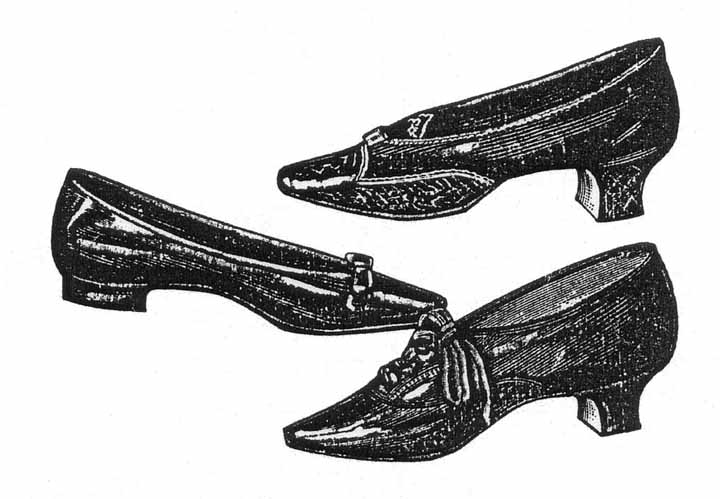
A moderate French heel is still preferred for evening and house shoes, while the lower and broader English heel
prevails for walking boots. Occasionally, however, a low heel is desired for an evening slipper, like that shown, which is of
patent leather, with moderate rounded toe. Much more pointed is a slipper in a combination of alligator and patent-leather, with
white silk stitching. The tie illustrated is of French kid foxed with patent-leather.
Harper's Bazar, 17 November 1894
|
Evening Ties and Slippers
Harper's Bazar, 17 November 1894
|
Evening Slippers
While the low English heel universally prevails for walking shoes, those for house and evening wear are still
preferred with the curved French heel of a somewhat modified form. Slippers for full evening dress match the gown in color; those
for simpler toilettes are either of light natural kid, black kid, or patent-leather. The slipper at the top of this group is of
light kid, with embroidery and a ribbon bow to match on the front. On the right is a blue satin slipper, with a white lace bow and
a small rhinestone buckle. A white kid slipper has the toe and the narrow strap on the instep embroidered with white and gold
beads. A high black French kid slipper has a tab on the instep held by a strap with a large steel buckle. A still larger buckle
of oxidized silver in Renaissance style is on the long-looped bow of a black patent-leather slipper.
Harper's Bazar, 18 January 1896
|

Evening Ties and Slippers
Harper's Bazar, 18 January 1896
|
OUTERWEAR
Evening Cloaks
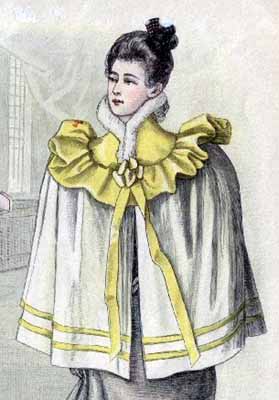
Large warm luxurious cloaks, enveloping the wearer like a domino, are worn in the evening. They are made of faced-cloths of light shades, of rich brocades, satin, bengaline, of the shot mirror velvet, with much trimming of fur, often of ermine,
or the crinkled fur of the Thibet goat, called also mandarin lamb. Sometimes they are a single great circle of pink, blue, tan,
or rose cloth warmly lined and mounted, with a full shoulder-cape of velvet of darker shade bordered with fur, and having a high
flaring collar. The brocades make full Watteau garments with the distinctive pleat in the back, while others are half-fitted
redingotes with huge bishop sleeves and elaulettes of mirror velvet showing all the shades in the brocade. For young girls are
shorter half circle capes that display their gowns and do not crush those light fabrics. Some of these are of fine cashmere lined
with pink silk and finished with a dark blue velvet cape and collar bordered with chinchilla. Ermine capes are in great vogue,
and are worn by old and young alike. The clouded moiré antique shot in two or three light colors is also used for very rich
cloaks, and in some the design is marked throughout with glittering spangles of jet, steel, or gold.
Harper's Bazar, 9 December 1893
|
Evening Cape
Illustrirte Frauen-Zeitung, 1 December 1893
|

P.O. Box 9, Nahant, Massachusetts 01908
e-mail:
phone: (781) 49-WALTZ (781-499-2589)
© 2011, Vintage Victorian, All rights reserved
|
|
NEWS:



last updated 24 jul 2014/csb
|