|
The highlight of our last balls, the Kör—the Hungarian Quadrille for 16 dancers from the year
1842—will not be tought during this year’s dance week, but dancers, who know it from the
years before can enjoy this dance performing at the ball (we plan on appropriate time to
review and rehearse).
As in the last years Hannelore and Andrea will present background information to dances,
repertory and practice at Viennese balls.
Set dances of the 19th century will be called at the balls and all dancers can join in without
prior knowledge.
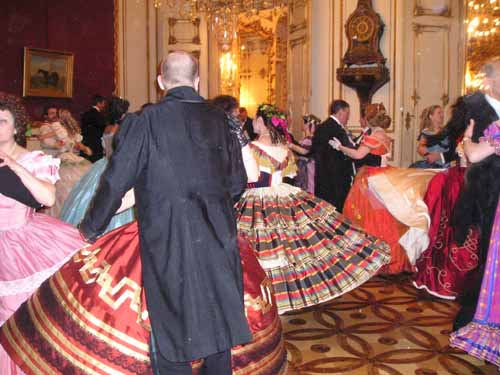 We meet Sunday February 2nd 2014 at 4.45 p.m. in the Prater Museum in the very center of
of the Viennese entertainment (1020 Wien, Oswald-Thomas-Platz 1)2; At free entry we get a
vivid impression of the changes in the history of Viennese entertainment culture.
(http://www.wienmuseum.at/en/locations/location-detail/pratermuseum.html). During the
19th century the former imperial hunting ground gathered diverse amusements and
attractions. In Arthur Schnitzler’s play La Ronde (der Reigen) the prater is not only
backgroud, but cannot be separated from the story. Ladies of the High Society note in their
diaries the excitement of the first ride in spring time and the Blumenkorso. Many relics of the
famous world exhibition 1873 wait there for us, as well as the magic world of a kind of early
Disneyland “Venice in Vienna.” Who wants to enjoy the overall view during a trip with the
Vienna giant ferris wheel (http://www.wienerriesenrad.com/en) joins Andrea at 4:00 pm at the
cash desk.
We meet Sunday February 2nd 2014 at 4.45 p.m. in the Prater Museum in the very center of
of the Viennese entertainment (1020 Wien, Oswald-Thomas-Platz 1)2; At free entry we get a
vivid impression of the changes in the history of Viennese entertainment culture.
(http://www.wienmuseum.at/en/locations/location-detail/pratermuseum.html). During the
19th century the former imperial hunting ground gathered diverse amusements and
attractions. In Arthur Schnitzler’s play La Ronde (der Reigen) the prater is not only
backgroud, but cannot be separated from the story. Ladies of the High Society note in their
diaries the excitement of the first ride in spring time and the Blumenkorso. Many relics of the
famous world exhibition 1873 wait there for us, as well as the magic world of a kind of early
Disneyland “Venice in Vienna.” Who wants to enjoy the overall view during a trip with the
Vienna giant ferris wheel (http://www.wienerriesenrad.com/en) joins Andrea at 4:00 pm at the
cash desk.
 Afterwards we walk to a nearby Cafe “Meierei” http://www.meierei.at/) in the famous Prater
Hauptallee (Nr. 3). which opened during the world exhibition 1873. There we can indulge
ourselves in eating, drinking, and dancing. Therefore we need a clear promise to come (or
not) to make the respective reservation.
Afterwards we walk to a nearby Cafe “Meierei” http://www.meierei.at/) in the famous Prater
Hauptallee (Nr. 3). which opened during the world exhibition 1873. There we can indulge
ourselves in eating, drinking, and dancing. Therefore we need a clear promise to come (or
not) to make the respective reservation.
Daily classes will start on February 3rd, from 10:00 am to 4:30 pm in Kolpinghaus, 9th district,
Althanstrasse 51 (tram D, stop Augasse). Hannelore and Andrea give classes both in German
and English. At the Kolpingshaus you have the possibility to get lunch for a minimum price.
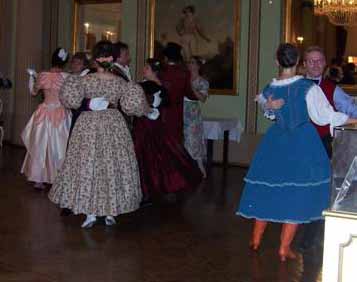
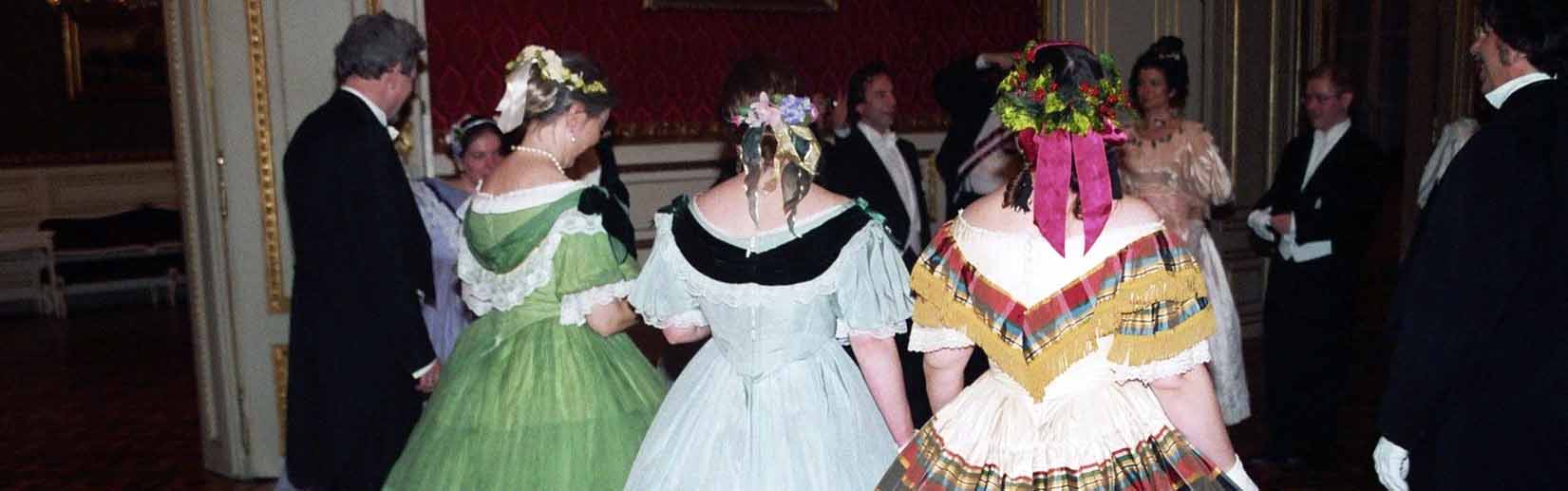
The motto of our fancy dress ball on Tuesday (6:00 pm) will be: “In the Viennese Prater.”
 There will be no classes on Wednesday afternoon, so participants are free to explore Vienna
or just rest their feet.
There will be no classes on Wednesday afternoon, so participants are free to explore Vienna
or just rest their feet.
The afternoon Tea Dance on Friday, February 7th from 3:00 pm to 6:00 pm, will unfold in
Biedermeier charm in the Straußelsälen, the last remaining dance hall in Vienna in which
Strauss and Lanner played for dances, with afternoon dress of the first half of the 19th century.
The evening ends in Cafe Landtmann, where we can sit together and order individually food
(reservation is necessery).
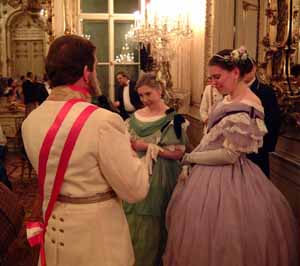
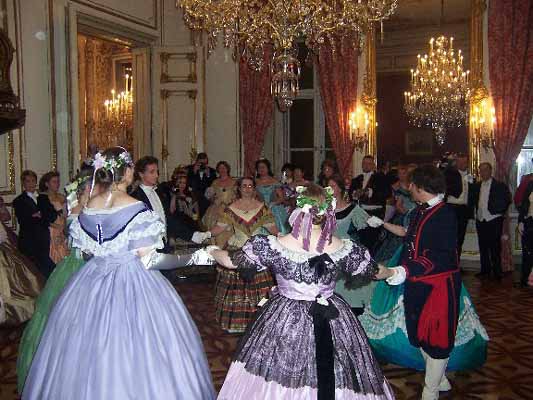
For the Grand Strauss Ball on February 8th we made reservation of the belle etage of the
Palais Daun-Kinsky (1010 Wien, Freyung 4): the oval ballroom, the Herren- and Damensalon
and the Gelber Salon, created by the well known baroque architect Johann Lucas von
Hildebrandt. There we can dance our Waltzes and Quadrilles, have our laid places at the
tables, enjoy Viennese’s specials arranged at the delicious buffet. There is also the possibility
to change our ball gowns there. http://www.palaisevents.at/en/palaisdaunkinsky.html
Following Viennese custom, we will have dance cards at the Ball made by Andrea as you can
see in the picture below. The dance program will include dances, we learned or rehearsed
during the week, the French Quadrille, the common turning dances (waltzes, polkas and Galops) and some contradances as the Sir Roger or the Cotillon (Germans), which will be called.
For participants of the danceweek the Saturday is free until 4:45 p.m. or optional the French Quadrille class as follows:
A Ball Preparation Class on The French Quadrille for dancers who do not attend the daily classes will be offered on February 8th from 10:00 am to 1:00 pm.
Hannelore Unfried
|


 Again for the ball season 2014 Hannelore and Andrea announce their danceweek in Vienna! We give new dances the chance
to become our favorite dances and put the most enjoyed dances on the ball programm taking place in the unique baroque palais Daun-Kinsky1.
The Ballet Master and dancing Master A. Küffel shows us new facets of the dance repertory for the Carneval in Prague of the year 1830:
The uncommon Kegel-Quadrille with the concluding Reidowak and an Anglaise, which he simply
calls Conversationstanz for two Ladies on either side of each Gentleman. We learn steps from the dancing Masters Häcker and Helmke
for the indispensable Ecossaisse. We will get out of our treasure box L’Alliance. Johann Raab
(königlich böhmisch ständische Tanzmeister) wants the figures of his Quadrille in lines to be performed in polka-mazurka steps.
The music to this dance was composed by Philipp Fahrbach Sr, who was bandmaster of the Vienna’s
Hoch- und Deutschmeister Regiment and directed the music to the Royal Court balls.
Again for the ball season 2014 Hannelore and Andrea announce their danceweek in Vienna! We give new dances the chance
to become our favorite dances and put the most enjoyed dances on the ball programm taking place in the unique baroque palais Daun-Kinsky1.
The Ballet Master and dancing Master A. Küffel shows us new facets of the dance repertory for the Carneval in Prague of the year 1830:
The uncommon Kegel-Quadrille with the concluding Reidowak and an Anglaise, which he simply
calls Conversationstanz for two Ladies on either side of each Gentleman. We learn steps from the dancing Masters Häcker and Helmke
for the indispensable Ecossaisse. We will get out of our treasure box L’Alliance. Johann Raab
(königlich böhmisch ständische Tanzmeister) wants the figures of his Quadrille in lines to be performed in polka-mazurka steps.
The music to this dance was composed by Philipp Fahrbach Sr, who was bandmaster of the Vienna’s
Hoch- und Deutschmeister Regiment and directed the music to the Royal Court balls.